
Generative Vision Interview Questions #23 - The Parameter Shrink Trap
Why cutting network width won't save your text-to-image inference costs, and how the progressive distillation trick collapses latency without sacrificing the canvas.

You’re in a Senior ML Engineer interview at Midjourney and the interviewer asks:
“Your text-to-image inference costs are killing the business. Your first instinct is to shrink the student model. Walk me through why that’s the wrong move, and what you’d cut instead.”
Don’t say: “Smaller model, fewer parameters, faster inference, just distill it down like DistilBERT.”
Too vague. And it exposes that you’re pattern-matching from the LLM playbook without understanding why it works there.
Here’s the reality most candidates miss:
In the LLM world, shrinking works. You distill BERT → DistilBERT, cut ~40% of the parameters, and retain ~97% of the performance. The KL divergence over the token distribution transfers the “shape” of the teacher’s knowledge cleanly into a smaller student.
In the image world, the same move falls off a cliff. Shrink the student’s width and quality collapses.
Why the asymmetry? Because your latency in diffusion/flow models isn’t dominated by model size, it’s dominated by the iterative sampling loop.
Think about it:
An LLM generates a token in one forward pass.
A diffusion model runs hundreds to a thousand forward passes to produce one image.
You’re not paying for a big model. You’re paying for the same model, run over and over. Shrinking the network attacks the wrong axis entirely, you’re trimming the cost of one step while the count of steps is what’s bleeding you.
The senior move: don’t touch the parameters. Collapse the trajectory.
Turn the knob that actually matters, NFEs (Number of Function Evaluations). Drive the sampling loop from 1000 steps toward 1.
But you don’t jump straight to one step. That’s the second junior trap, asking a single stroke to reproduce the entire painting. Too much information for one forward pass.
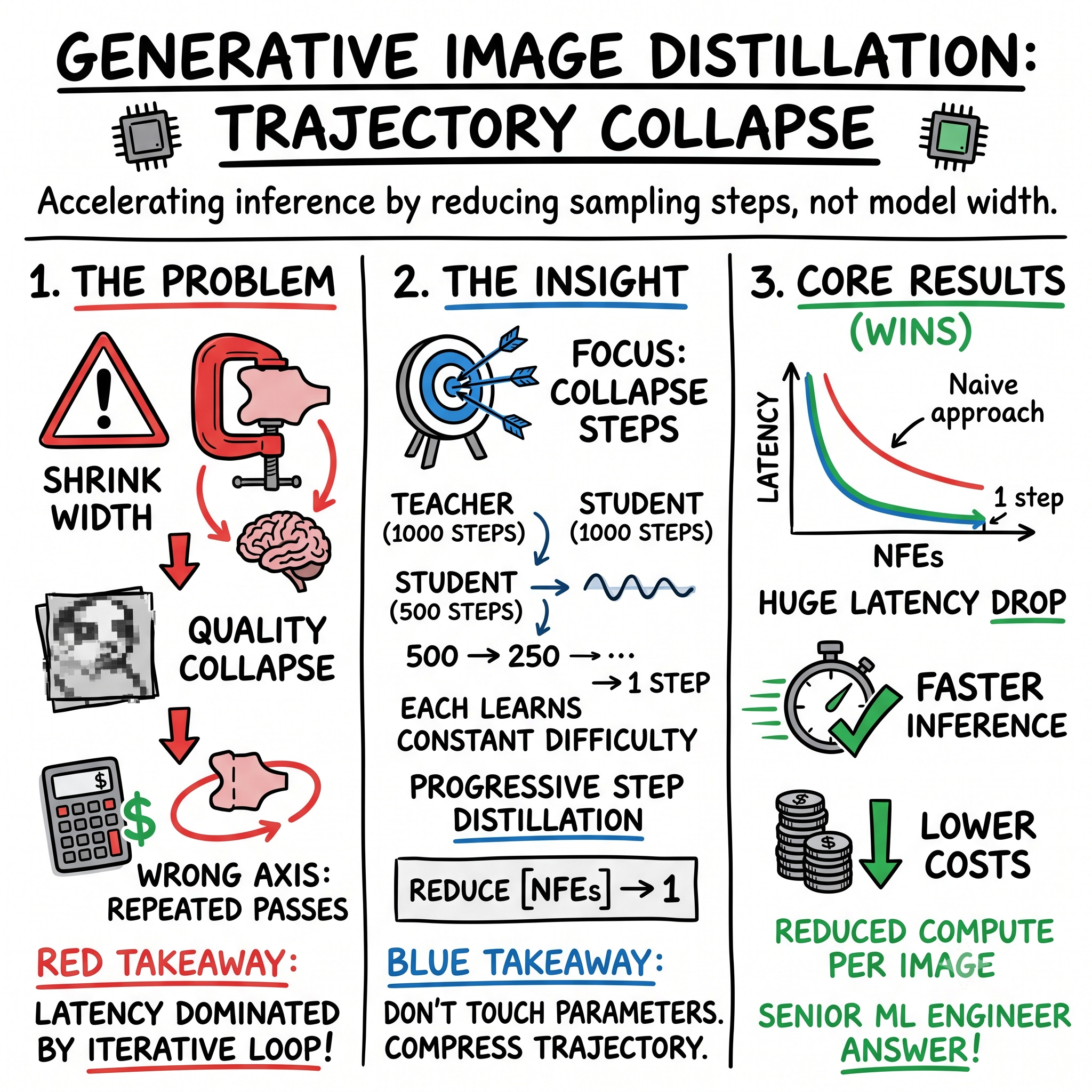
Instead: progressive distillation. Halve the steps, distill, halve again. Each student learns a problem of roughly constant difficulty (2 teacher steps → 1 student step), and you iterate until a single pass gets you there.
The answer that gets you hired: In generative image models, the bottleneck is the length of the sampling trajectory, not the width of the network. You don’t compress the model, you compress the number of function evaluations, and progressive step distillation is how you do it without asking one stroke to paint the whole canvas.
#MachineLearning #DiffusionModels #GenerativeAI #MLEngineering #AIInfrastructure #ModelDistillation #DeepLearning
📚 Related Papers:
- DistilBERT, a distilled version of BERT: smaller, faster, cheaper and lighter. Available at: https://arxiv.org/abs/1910.01108
- Progressive Distillation for Fast Sampling of Diffusion Models. Available at: https://arxiv.org/abs/2202.00512
- SlimDiff: Training-Free, Activation-Guided Hands-free Slimming of Diffusion Models. Available at: https://arxiv.org/abs/2509.21498
- InstaFlow: One Step is Enough for High-Quality Diffusion-Based Text-to-Image Generation. Available at: https://arxiv.org/abs/2309.06380